
RIGOROUS INSPECTION
It’s been a memorable few years for Caputo. Turnover growth in 2024 led to a reported figure of 227 million Euros, with exports to around 90 countries. As the leading pizza flour brand in Italy, it’s continuing to maintain increased sales in the most competitive and discerning market in the world. But other ambitions are just as important.
Caputo’s second sustainability report, again relating to 2024 when the business celebrated its centenary, illustrates how its values and activities always respond to respect for the social and environmental context.
Production capacity is articulated across two operational headquarters: one in Naples, the other in Campobasso. Plants are completely automated and equipped with state-of-the-art instrumentation, ensuring maximum quality and safety – with every batch of grain subjected to rigorous inspection and lab controls.
These detailed principles also apply to a clear commitment to the environment and the territory, based on a concrete and measurable approach. This is aimed at managing resources consciously, enhancing the supply chain and progressively reducing impacts.
HAT-TRICK OF GOALS
There are three key aspects on which Caputo’s commitment to environmental responsibility are based:
- Enhancement of the territory and its resources. Via supply chain projects in synergy with stakeholders and the cultivation of organic soft wheat flours.
- Energy efficiency and maximisation of the use of renewable energy, with important and continuous investment.
- Waste and emission reduction. An approach based on knowledge and recycling/reuse of processing waste.
Running through the core of the business is a link with its home, Naples. This manifests via concrete urban regeneration actions. These include Miller’s New Year (celebrating its eighth edition), which acknowledges the start of the harvest and renewal of the supply chain agreement with Green Farm, reaffirming sustainability as a priority.
The adoption of the Aragonese Towers Gardens began in 2023, for the 100x100 Naples Foundation. Caputo adopted the green area in via Marina, contributing to its maintenance and redevelopment to this day.
While the Grano Nostrum supply chain is a continuing pact for quality agriculture. It is here, in the Campo Caputo, that grain is cultivated, 100% Italian.
Grano Nostrum is a complete supply chain project, from seed to flour, aiming to enhance both Italian quality agriculture and the art of slow milling. A large group of farmers operating on 3000 hectares in the Southern regions participate in this project. The produced flour is a balanced blend of six different varieties of soft wheat, among which the Dom Carmine variety stands out, named in honour of Carmine Caputo – president of Molino Caputo.
The supply chain contract includes a reward system that protects the work of small agricultural entrepreneurs, promotes scientific research and optimises every phase of agricultural work – from sowing to harvesting, up to storage techniques, to ensure homogenous yield naturally throughout the year.
THE FUTURE
Any sustainability strategy has to appreciate the importance of rational energy management. It can be a complex beast, especially in the world of energy-intensive milling.
Caputo has consolidated the approach, aimed at optimising consumption, improving efficiency and increasing self-production from renewable sources. The energy management system allows the analysis of individual production departments in real time, promptly identifying inefficiencies and intervening with corrective actions. This precise energy management ensures economic savings and reduced environmental impact. And electric energy is the main carrier, representing 99% of total consumption.
One example of continued innovation is process efficiency at the historic Naples site. In 2024, Caputo launched a modernisation project for the pneumatic transport system, which was responsible for about 15% of total electricity requirement. It involved replacing the head and tail turbines with new-generation models, equipped with higher efficiency motors and inverter regulation to optimise the operating point based on actual demand.
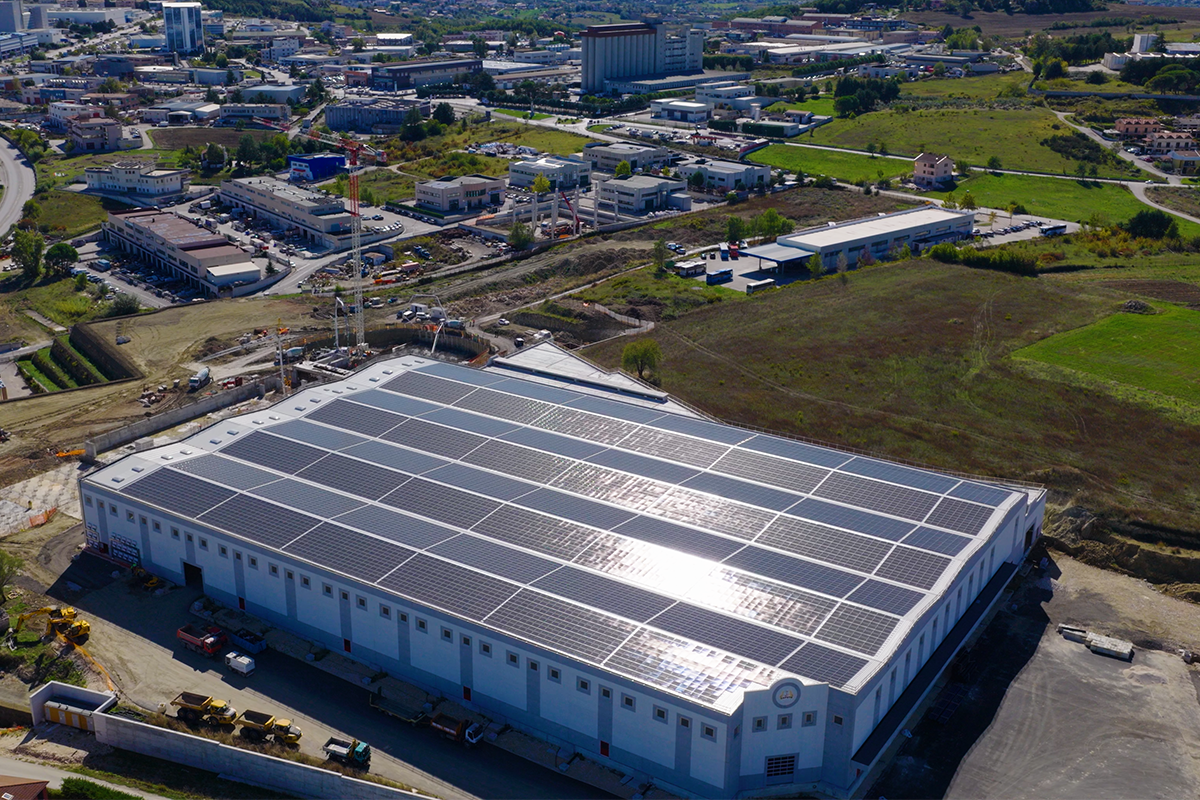
And these ambitions are ultimately reflected in the Ripalimosani site in Molise, set to open next year, with a new photovoltaic system. As the most sustainable mill in Europe, it will cover a mammoth 20,000 sq m, 100% powered by solar energy, thanks to panels covering the entire exterior surface.
We will be there for the unveiling – and it’s all set to establish new standards in the flour milling production journey.